An armwrestling exercise map: what to train, why and where to start
Navigate 18 guides covering general strength, hand and forearm functions, technique-specific sessions and a practical weekly plan. Learn how to select rather than stack exercises.
Contents
Start with a task, then the muscles
Start with what must stay strong at the table. Finger containment, wrist flexion, forearm rotation, elbow-angle retention and shoulder-to-hand connection are different tasks. A stronger curl does not automatically preserve pronation against an opponent's hand.
Wrist flexors support cup; finger flexors support containment; pronation and supination rotate the forearm. Rise concerns thumb-side and knuckle height. Back pressure combines elbow flexion with drawing the upper arm toward the body. No single muscle is the 'toproll muscle'.
Three levels of the library
Level one covers general lifts and scheduling. Level two separates cup, fingers, pronation, rise, supination, back pressure and side pressure. Level three assembles those capacities for each technical family.
Begin with the classics and weekly plan, then select one relevant function guide and one technique guide. These are alternatives and learning resources, not 18 workouts to complete every week. Shared cup or pronation work still counts when used in several styles.
Sets, repetitions, holds and effort
2 × 12 means two sets of twelve complete repetitions; 2 × 10 seconds means two holds. A repetition includes controlled lifting and lowering. A hold requires active muscle effort rather than resting the load on a joint or support.
The starter examples generally leave three to four clean repetitions in reserve. End holds before position fails and continue breathing. These are adjustable practice examples for healthy adults, not mandatory kilogram targets or injury rehabilitation prescriptions.
Movement, holds and skill transfer
Dynamic work develops control through a usable range. Holds practice retaining a selected position, but strength at one angle is not identical across all angles. Learn slow movement before adding modest isometrics or very short heavy lifts.
At the table, ask which position survives controlled resistance rather than how much weight you lifted. Use cooperative drills with an agreed resistance and stop signal. Gym progress is not proof of readiness for maximal sparring.
Choose the link that fails first
An opening wrist suggests reviewing cup and cable direction; peeling fingers suggest containment. Losing palm orientation calls for checking pronation and strap placement. An opening elbow despite a controlled hand suggests reviewing back pressure. These are questions for assessment, not diagnoses from a still photograph.
Film a light drill from the side and ask whether position or strength failed first. Change one variable for several sessions, then reassess. Avoid simultaneously increasing load, sets, frequency and table time.
What the evidence does and does not support
ACSM's 2026 guidance supports consistent resistance training and individual progression without requiring failure on every set. It addresses healthy adults generally, not comparative trials of hook or King's Move programs.
A 2023 EMG study involving ten men shows that different forearm exercises recruit muscles differently. Acute activation does not establish long-term match performance or injury prevention. Coaching videos inform setup and application; the example schedules here are editorial starting points, not the coaches' original programs.
Start small and know when to stop
A session can begin with one general pull, one elbow-flexion exercise, one wrist exercise and one rotation exercise. Warm up generally and rehearse each setup with progressively lighter-to-working loads. Secure equipment and leave a clear path for lowering the weight.
Stop for sharp pain, numbness or loss of control. Persistent symptoms require individual assessment. The armwrestling injury review highlights torsion and sudden force changes; no angle or load in this library guarantees freedom from injury.
Exercise video reference
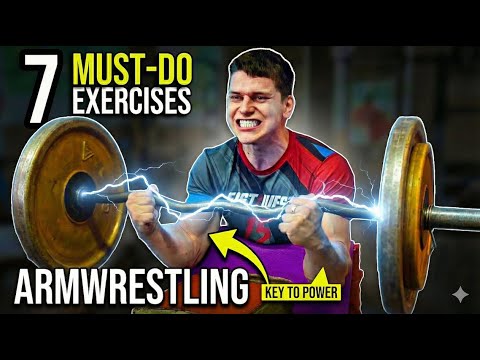
Use the video to study movement order and equipment setup. The sets and repetitions in this guide are Hub's adjustable starting examples for healthy adults, not the filmed athlete's prescription or a pain-treatment protocol.
Continue the exercise library
Foundations and scheduling
- The classic armwrestling strength lifts: curls, rows, pull-ups and triceps
- Build an armwrestling week: two strength sessions, table time and progression
Force and function guides
- Training cup: wrist curls, position holds and finger containment
- Finger strength and containment: more than closing a gripper
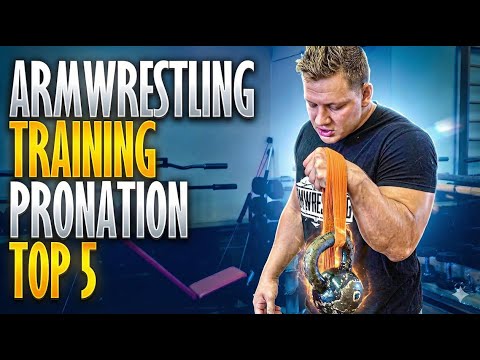
- Pronation training: straps, cables and retaining hand orientation
- Rise and riser training: preserve hand height without shoulder cheating
- Supination training: controlled rotation to support hook entry
- Back-pressure training: elbow-angle retention and drawing the arm back
- Side-pressure training: controlled lateral force and shoulder connection
Technique applications
- A hook training session: cup, containment, supination and closeness
- High-hook training: height, controlled cup and retained rotation
- Toproll training: combine pronation, pulling and hand retention
- Posting-toproll training: height with usable pulling and rotation
- Low-hand-toproll training: lower-hand rotation with retained grip
- Press training: triceps, pushing strength and controlled transitions
- Preparing for a flop-wrist press: pushing capacity and controlled wrist opening
- Preparing for the King's Move: pronation and active open-angle defense
Sources & further reading
- Voice of Armwrestling — Arm Wrestling Exercises: 7 Gym Moves for Strength & Table Power
- Voice of Armwrestling — Arm Wrestling Training: 5 Essential Exercises
- ACSM 2026 — khuyến nghị tập sức mạnh cho người trưởng thành khỏe mạnh
- Fukunaga và cộng sự, 2023 — EMG trong bài pronation và ulnar deviation, 10 người
- Ogawa và cộng sự, 2022 — tổng quan 153 ca gãy thân xương cánh tay khi vật tay
- Voice of Armwrestling — Finger and Grip training (ARM WRESTLING EXERCISE)
- Voice of Armwrestling — How To Train Pronation For Armwrestling | 5 Best Exercises