Preparing for the King's Move: pronation and active open-angle defense
Develop supporting rotation and pulling capacities without elbow suspension, then approach open-angle defense only through coached, controllable practice.
Contents
Train defense, not passive joint locking
The King's Move is advanced outside defense, not simply lowering the body and hanging from the elbow. Trainable supporting capacities include pronation, hand connection, pulling and active control of a more open angle. A low body silhouette is not a conditioning target.
Beginners can study the concept and train the general capacities without reproducing a deep match position. This guide does not prescribe elbow locking, whole-body suspension or end-range hits. The linked technical guide discusses WAF and EVW distinctions.
Exercise A: supported pronation at a comfortable angle
Support the elbow and use light resistance that tries to supinate the hand. Retain a chosen neutral or modestly cupped wrist, pronate or hold through a small segment and return slowly. Start with a familiar elbow angle instead of straightening the arm to resemble defense.
Use two sets of 10–15 with three to four repetitions in reserve. Avoid torso twisting against a fixed hand. This counts as the same pronation workload already used in toproll training.
Exercise B: controlled pulling and lowering
Choose a cable/hammer curl or row from the basic guide. Keep the shoulder comfortable, retain the wrist and repeat a controlled lifting and lowering path. Reduce load if the elbow angle or wrist fails instead of stopping it passively at a joint.
Start with two sets of 8–12, about three repetitions in reserve. This develops a pulling baseline rather than reproducing all defensive forces. Deliberate unloading matters alongside the lift itself.
A more open angle is a new loading condition
After a coach confirms control at familiar angles, a slightly more open elbow position can be explored with a substantially reduced load. Retain active elbow flexion and the ability to exit; do not lock straight to rest. Recheck routing and cable direction.
Coached familiarization may use only a few short 5–8-second holds, well before failure, without increasing opening and weight together. This is not required unsupervised homework. Without coaching, keep the familiar basic exercise.
Table drill: light defense with an exit command
With a coach and cooperative partner, retain pronation in a shallow defensive position under slowly increasing light resistance. Every repetition includes an immediately obeyed release/reset command. The goal is deliberate exit and unloading, not holding until the joint stops the movement.
Do not test whether a partner can press through a passive stop, hit an open arm or fix the hand while the torso turns away. A repetition ends when a controlled exit is lost, not only when a pin occurs.
Competition rules are not a safety certificate
WAF and EVW express shoulder/upper-arm limits differently. Read the specific event's rules rather than copying a historically accepted photograph. Pad contact or lack of a referee call does not certify suitable tissue loading.
Ordinary pronation and curl training does not make someone a King's Move specialist. Distinguish a strength exercise, a learning drill and a competition technique rather than presenting a common gym lift as a scientifically validated secret.
Modest volume and useful progress markers
A basic session may use two pronation sets and two pulling sets plus an appropriate accessory. Coached open-angle practice replaces some pulling work rather than being added after fatigue. Improve orientation and controlled lowering before discussing load.
The injury review and 2026 observational study provide no guaranteed-safe opening angle or kilogram threshold. Stop for sharp pain, numbness, unusual weakness or lost control. Persistent symptoms require individual assessment; passive locking tolerance is not a progress marker.
Exercise video reference
Use the video to study movement order and equipment setup. The sets and repetitions in this guide are Hub's adjustable starting examples for healthy adults, not the filmed athlete's prescription or a pain-treatment protocol.
Read the matching technique guide
Continue the exercise library
- An armwrestling exercise map: what to train, why and where to start
- Pronation training: straps, cables and retaining hand orientation
- Back-pressure training: elbow-angle retention and drawing the arm back
- Toproll training: combine pronation, pulling and hand retention
- Build an armwrestling week: two strength sessions, table time and progression
Sources & further reading
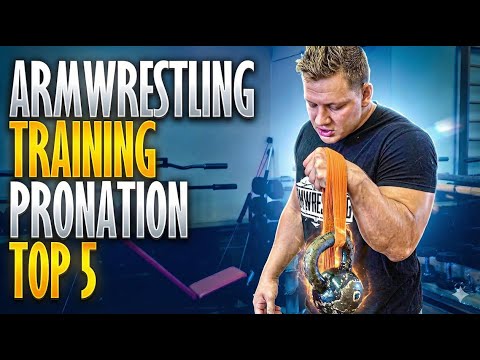
- Voice of Armwrestling — How To Train Pronation For Armwrestling | 5 Best Exercises
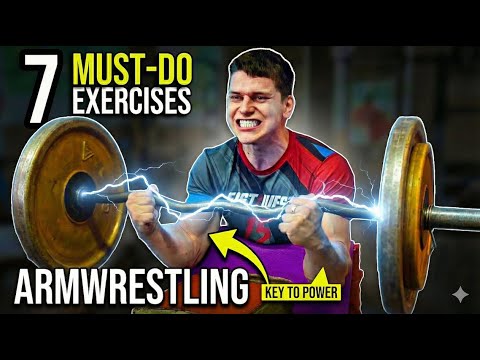
- Voice of Armwrestling — Arm Wrestling Exercises: 7 Gym Moves for Strength & Table Power
- Voice of Armwrestling — Arm Wrestling Training: 5 Essential Exercises
- Ogawa và cộng sự, 2022 — tổng quan 153 ca gãy thân xương cánh tay khi vật tay
- Öğümsöğütlü và Özcan, 2026 — nghiên cứu quan sát 74 video chấn thương
- East vs West — luật thi đấu, gồm tư thế nguy hiểm và giới hạn phòng thủ
- WAF Rules 2025 — quy định tư thế thi đấu
- ACSM 2026 — khuyến nghị tập sức mạnh cho người trưởng thành khỏe mạnh
- World Armwrestling League — King's Move Decoded, tư liệu 2019
- Tarzan / Magazine House — hướng dẫn wrist curl và pronation, ảnh 小川朋央, chỉ dẫn 清水忍
- Voice of Armwrestling — World Champion Armwrestling Training (Full Workout)