Rise and riser training: preserve hand height without shoulder cheating
Learn radial-deviation work, strap riser holds and pulling combinations while distinguishing wrist height from elbow or shoulder movement.
Contents
Rise is a hand function, not a separate muscle
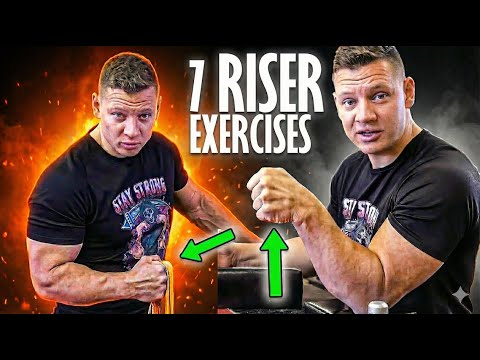
Rise usually refers to preserving thumb-side and knuckle height in the grip. Gym versions use radial deviation or resist a force that lowers that edge. Wrist stabilizers contribute, while table grip and elbow position also affect apparent height.
Raising the entire arm is not the same task. A shoulder shrug can hide a collapsing wrist. Inspect the hand relative to the forearm before combining it with larger pulling actions.
Exercise one: supported radial deviation
Support the forearm with the thumb facing up and wrist near the support edge. Use a short lever with minimal resistance that tends to lower the thumb side. Raise that edge through a small controllable range without lifting the forearm, then lower slowly.
Try two sets of 12–15, leaving three to four repetitions. This is naturally a small movement. On an offset implement, a longer exposed lever increases torque even without another plate, so begin close to the weighted end.
Exercise two: inspect the strap path
Use a flat soft strap across the knuckle region so the load tends to lower the hand edge you are retaining. Do not tighten a loop around an individual finger. Support the elbow, lift only clear of the support and preserve the wrist position with a clear lowering path.
Begin with two light holds of 8–10 seconds, breathing continuously and ending before the wrist changes. If the force direction is unclear, rehearse with minimal elastic resistance or seek coaching. Painful pressure or numbness requires a setup change.
Exercise three: combine rise with a short pull
Once the isolated position is reliable, reduce the load and add a short elbow-flexion pull. Preserve the hand-to-forearm relationship rather than using leg drive. Move slowly enough to see whether rise disappears as the pull begins.
Use two sets of 8–10 as an alternative to the holds. This also loads back pressure, so account for existing hammer or belt curls. The goal is coordinated retention rather than an extra exercise name.
Three common substitutions
Shrugging raises the whole arm while the wrist collapses. Leaning back uses body travel to lift the weight. Strap migration can move resistance closer to the wrist axis and reduce torque. A new number is comparable only under similar leverage.
Film from wrist height and record elbow support and strap placement. Marking the strap can help repeat the setup. Stop when another movement takes over and count only the last clean repetition.
Posting and high-hook applications
Posting toproll makes height retention obvious, and a high hook also uses it alongside cup and rotation. At the table, pursuing height at any cost can compromise grip or elbow position. Strength is only one part of the technical problem.
In a cooperative grip, let a partner gradually apply gentle downward pressure while you retain modest height, release deliberately and reset. Avoid fingertip tugging, lifting the elbow off the pad or turning the drill into a longest-hold contest.
Progression and limits
Start with one variation per session. Add clean repetitions before dynamic load, or repeat the same hold duration and wrist angle before a tiny increase. A longer lever with the same weight is already a harder setup.
Coach Ray supplies practical variations and ACSM supports general progressive training. These sources do not establish a universal riser benchmark or a load guaranteed to beat an opponent. Stop for wrist pain or numbness instead of squeezing harder to compensate.
Exercise video reference
Use the video to study movement order and equipment setup. The sets and repetitions in this guide are Hub's adjustable starting examples for healthy adults, not the filmed athlete's prescription or a pain-treatment protocol.
Continue the exercise library
- An armwrestling exercise map: what to train, why and where to start
- Posting-toproll training: height with usable pulling and rotation
- High-hook training: height, controlled cup and retained rotation
- Pronation training: straps, cables and retaining hand orientation
- Back-pressure training: elbow-angle retention and drawing the arm back
- Build an armwrestling week: two strength sessions, table time and progression
Sources & further reading
- Voice of Armwrestling — Arm Wrestling Riser: 7 Exercises for Maximum Strength
- Voice of Armwrestling — Arm Wrestling Exercises: 7 Gym Moves for Strength & Table Power
- ACSM 2026 — khuyến nghị tập sức mạnh cho người trưởng thành khỏe mạnh
- Ogawa và cộng sự, 2022 — tổng quan 153 ca gãy thân xương cánh tay khi vật tay
- Voice of Armwrestling — How To Train Pronation For Armwrestling | 5 Best Exercises