High-hook training: height, controlled cup and retained rotation
Combine rise, cup and rotation for a high-hook emphasis, with a cooperative entry drill and clear distinctions from simply adding more inside work.
Contents
Preserve several options at once
A high hook is not simply a hook with the whole arm raised. Here it means retaining hand height and rotational options while entering inside. Coaching terminology varies, so train observable tasks: thumb-side height, cup and controlled palm orientation.
Burying the grip early then pulling upward can create a different task. Use light drills to see whether height costs cup or elbow contact. Coordination does not require stacking all riser work on a full deep-hook program.
Exercise A: supported rise with a short lever
Support the forearm thumb-up and use light resistance that tends to lower the thumb side. Raise that edge through a small range and lower slowly without shrugging. Confirm the intended direction with rehearsal repetitions.
Use two sets of 12–15 or two holds of 8–10 seconds, choosing one. Repeatable height retention is more relevant than a body-assisted record. Record strap placement and exposed lever length because both alter torque.
Exercise B: cup without giving away height
Use a cable cup or cylindrical handle and establish moderate wrist flexion without dropping the hand edge. Keep the elbow controlled. Maximal wrist flexion is not required; retain a shape that still allows height and rotation.
Try two sets of 10–15 with three to four repetitions in reserve. Use a smaller handle or less load if contact is lost. Avoid making the image look high by extending the fingertips or compensating for a collapsed wrist with the shoulder.
Exercise C: pronation with a modest cup
Route the strap to create a supinating moment, establish a modest cup and retain pronation during a small pull. Reduce load or separate the actions if cup disappears. Keep the chosen shoulder/elbow path instead of throwing the torso.
Use two sets of 8–12 in place of other pronation work. Large visible rotation is unnecessary once orientation is retained. Include deliberate lowering so the cable cannot jerk the hand back.
Drill: retain height, enter inside and reset early
With a cooperative partner at center, establish manageable grip height, then cup and enter gently inside. The partner provides steady light resistance rather than a downward hit. Pause briefly while control remains, unload and reset for a few clear repetitions.
Reset if knuckles drop substantially, the elbow rises or shoulder-hand control is lost. Recognizing the end of the intended technique is part of learning, not a failure to overpower.
A three-task session rather than six exercises
A session might use two sets each of rise, cup and pronation. If elbow flexion is needed, replace part of the combined work with a curl rather than adding indefinitely. Another hook day can emphasize supination and closeness.
Reduce corresponding gym work when table practice is included. Hold time, repetitions and load all contribute to workload. Rest enough to preserve hand shape, commonly 60–120 seconds for these light examples.
Assess functions before increasing load
Film a light drill from the side and front and check whether rise and cup coexist. After repeatable sessions, add a tiny increment to one limiting exercise while keeping the others stable. A better unrelated lift does not establish a better complete high hook.
The coaching sources provide practical rationale, not a trial identifying one optimal high-hook program. Stop for sharp pain, numbness or a fixed hand with uncontrolled shoulder rotation. Height is not a reason to support the load passively through joints.
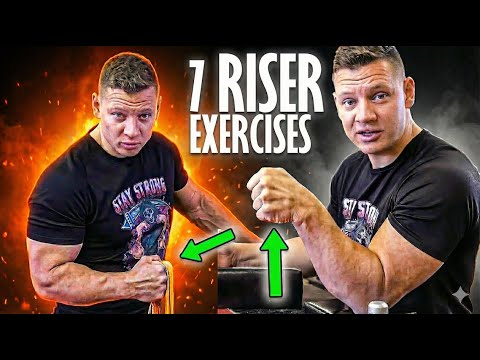
Exercise video reference
Use the video to study movement order and equipment setup. The sets and repetitions in this guide are Hub's adjustable starting examples for healthy adults, not the filmed athlete's prescription or a pain-treatment protocol.
Read the matching technique guide
Continue the exercise library
- An armwrestling exercise map: what to train, why and where to start
- A hook training session: cup, containment, supination and closeness
- Rise and riser training: preserve hand height without shoulder cheating
- Training cup: wrist curls, position holds and finger containment
- Pronation training: straps, cables and retaining hand orientation
- Posting-toproll training: height with usable pulling and rotation
- Build an armwrestling week: two strength sessions, table time and progression
Sources & further reading
- Voice of Armwrestling — Arm Wrestling Riser: 7 Exercises for Maximum Strength
- Voice of Armwrestling — How To Train Pronation For Armwrestling | 5 Best Exercises
- Voice of Armwrestling — Arm Wrestling Training: Dumbbell Wrist Curls for Cupping
- Voice of Armwrestling — Arm Wrestling Exercises: 7 Gym Moves for Strength & Table Power
- Ogawa và cộng sự, 2022 — tổng quan 153 ca gãy thân xương cánh tay khi vật tay
- ACSM 2026 — khuyến nghị tập sức mạnh cho người trưởng thành khỏe mạnh
- Table Monkeys — The High Hook / How It's Done
- Tarzan / Magazine House — hướng dẫn wrist curl và pronation, ảnh 小川朋央, chỉ dẫn 清水忍
- Voice of Armwrestling — PRONATION EXERCISES WITH LOW CABLE FOR ARMWRESTLING