Supination training: controlled rotation to support hook entry
Practice strap and short-lever supination, then combine it with cup without twisting through the shoulder or thumb joint.
Contents
Supination supports an inside entry
Supination rotates the forearm toward palm-up. Biceps and supinator contribute according to elbow position and resistance. Inside pulling also needs cup, containment and closeness; rotation alone may not establish a hook from a lost hand position.
Distinguish forearm rotation from rolling the entire shoulder and torso inward. If the body does most of the work, the kilogram number describes a different task. Establish the forearm action lightly before combining joints.
Exercise one: supported band supination
Support the elbow and forearm and begin near neutral. Arrange the band so it tries to turn the palm down; rotate palm-up against it. Keep the wrist near straight and shoulder stable, use a modest controlled range and return slowly.
Start with two sets of 12–15, leaving three to four clean repetitions. Lay the strap flat rather than tightening it around the thumb joint. Mark your distance from the anchor because stretching an elastic band farther increases resistance; inspect the anchor and band before use.
Exercise two: a short, light lever
Use a secure offset implement and initially hold near its weighted end. Support the elbow, retain a straight wrist and orient the load so gravity opposes the intended rotation. Supinate slowly through a comfortable segment, then lower actively; use the other hand to help position the unloaded start if needed.
Use two sets of 10–12 instead of band work. Leverage can change dramatically with grip distance. Do not let the implement flip through end range, flick it with the wrist or test a maximum in an unfamiliar position.
Exercise three: add rotation to an established cup
Establish a moderate cup with a light cable handle, then add a small amount of supination while retaining it. Reverse both actions deliberately. Separate the phases slowly enough to identify the failing link instead of jerking through with the shoulder.
Use two sets of 8–10 in a hook-focused session in place of isolated rotation that day. Adjust routing if pressure concentrates at the thumb joint or bends the wrist sideways. Load the hand's rotation rather than twisting an individual digit.
Do not use forced partner end-range twisting
Agree on direction and speed before a table drill. Work near center with a cooperative partner and reduce resistance when either person loses controllable alignment or feels discomfort. Small, steady resistance is enough to learn an inside entry.
Do not let a partner suddenly twist you outward while you resist inward. A painful grip hold is not evidence of tendon strength. The armwrestling injury review highlights torsion and sudden force changes, including in apparently strong participants.
Combine it with rotation in the other direction
You can place supination on one day and pronation on another, or use small amounts of each if total volume is low. There is no mandatory 1:1 kilogram ratio across different leverage and range. Hook training also requires containment and elbow flexion rather than only maximal inward rotation.
A compact selection could include two sets each of hammer curls, cup and supination, with pronation and rows emphasized another day. Reduce overlapping work after inside table practice. These are choices within a plan, not extra obligations.
Progression and interpreting the source
Increase only after repeatable rotation with a stable wrist and acceptable next-session response. Add a small load or a repetition, not leverage and plates together. Record band type, stretch distance and anchor because colors are not standardized between brands.
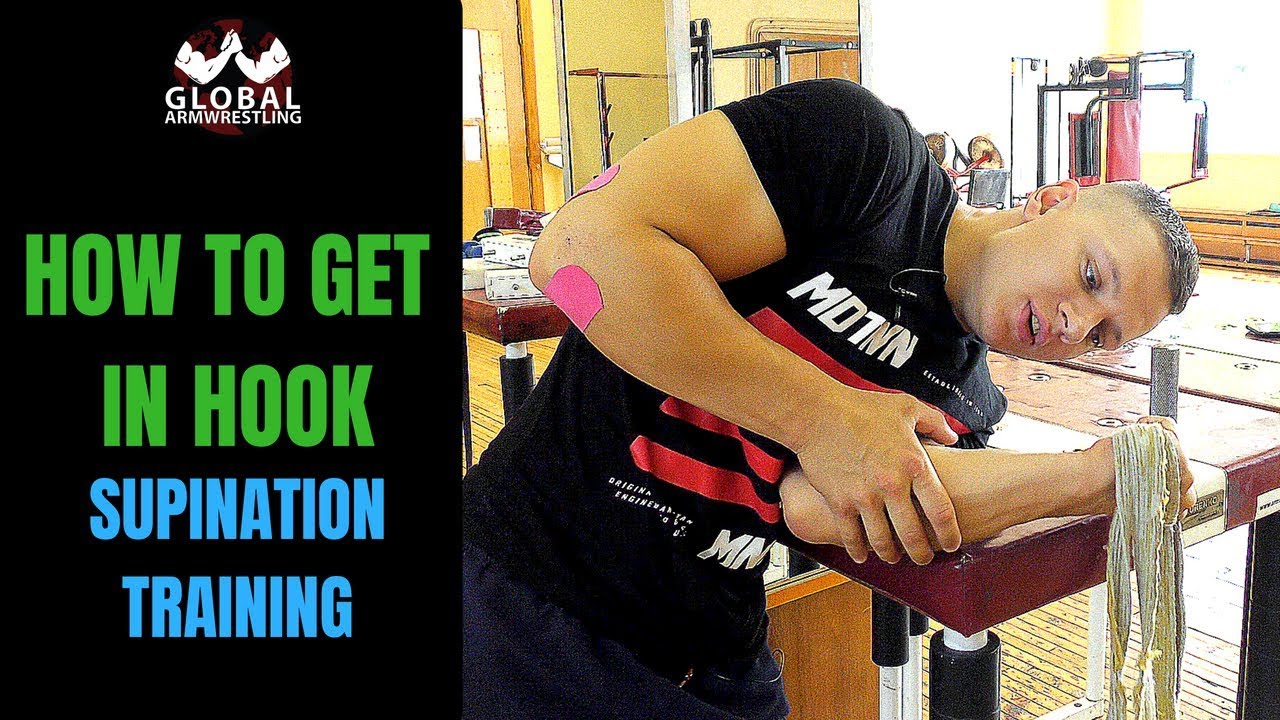
The coaching video illustrates supination work for a hook, not proof that a schedule treats pain or guarantees entry against every opponent. Previous elbow or wrist problems need individual modification. Stop for sharp pain, numbness or inability to lower under control.
Exercise video reference
Use the video to study movement order and equipment setup. The sets and repetitions in this guide are Hub's adjustable starting examples for healthy adults, not the filmed athlete's prescription or a pain-treatment protocol.
Continue the exercise library
- An armwrestling exercise map: what to train, why and where to start
- A hook training session: cup, containment, supination and closeness
- High-hook training: height, controlled cup and retained rotation
- Training cup: wrist curls, position holds and finger containment
- Pronation training: straps, cables and retaining hand orientation
- Build an armwrestling week: two strength sessions, table time and progression
Sources & further reading
- Voice of Armwrestling — ISOLATED SUPINATION TRAINING FOR ARMWRESTLING
- Voice of Armwrestling — How To Train Pronation For Armwrestling | 5 Best Exercises
- ACSM 2026 — khuyến nghị tập sức mạnh cho người trưởng thành khỏe mạnh
- AAOS OrthoInfo — nhóm gấp–sấp và đau mặt trong khuỷu
- Ogawa và cộng sự, 2022 — tổng quan 153 ca gãy thân xương cánh tay khi vật tay
- Voice of Armwrestling — CABLE WRIST CURLS for ARM WRESTLING TRAINING