Posting-toproll training: height with usable pulling and rotation
Progress from supported rise to coordinated pulling and pronation, with a cooperative posting drill and a compact adjustable session.
Contents
Height is a priority, not the whole technique
Posting prioritizes knuckle height and pulling from that position. A high hand with lost palm orientation or an opening elbow is not a complete structure. Rise, pronation and back pressure must coexist, with cup chosen to preserve the intended task.
Identify whether height disappears in the grip, at pull initiation or during a hold. Setup, coordination and endurance require different responses. More riser weight is not the answer to every low hand position.
Exercise A: supported rise
Support the forearm thumb-up and use a light strap or lever that tends to lower that edge. Raise it through a small range while keeping support contact, then lower slowly. Shoulder elevation is a different action.
Use two sets of 12–15 with three to four repetitions in reserve and 60–90 seconds rest, or two 8–10-second holds instead. Keep routing consistent and comfortable rather than shifting it mid-set or tightening around one digit.
Exercise B: pull while preserving rise
Use less load than an isolated elbow curl and keep the learned riser strap placement. Flex the elbow a short distance while retaining thumb-side height, then lower along the same path without body drive.
Use two sets of 8–10 in place of that day's hammer or strap curl. Separate the tasks if the wrist collapses immediately. Rest the load on its support before adjusting straps or pausing between sets.
Exercise C: retain rotation at useful height
With a light cable, route a supinating resistance and retain moderate hand height while producing or holding pronation. Do not seek maximal height at the expense of a strained shoulder or collapsing wrist; lower the position or load as needed.
Use two sets of 10–12 with about three repetitions in reserve. Separate pronation first if necessary. Changed leverage or torso lean is not a directly comparable load increase.
Center-table drill with retained elbow contact
With a cooperative partner, establish manageable grip height and make a small pull against gradually increasing light resistance. Unload and reset without a lateral finish. The target is height retention during controlled movement.
Reset when elbow contact, wrist shape or controllable shoulder-hand position is lost. Do not hook a partner's fingertips to keep yourself high. A light side-view recording is more informative than a whole-body still.
Keep the session compact
An example is two sets each of supported rise, rise-retaining pulls and pronation. Replace the combined pull with a hammer curl if coordination is not ready. Put cup/finger work elsewhere or substitute it rather than adding automatically.
Reduce overlapping gym sets when table drills are included. Rest 60–120 seconds for these light examples, or longer to restore the intended hand shape. Fatigue-driven shrugging and wrist collapse are not useful repetitions to force through.
Use comparable conditions
Keep routing, support, cable direction and range comparable across sessions. Add a small increment to the priority lift after clean upper-range sets and acceptable next-session response. Partner size, fatigue and grip make pin results an imperfect isolated measure.
The coaching and general strength sources do not provide a universal posting kilogram standard. Stop for sharp pain, numbness or inability to unload. Do not preserve height through a painful joint or a lifted elbow.
Exercise video reference
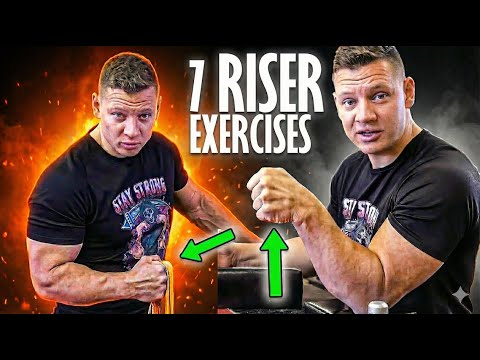
Use the video to study movement order and equipment setup. The sets and repetitions in this guide are Hub's adjustable starting examples for healthy adults, not the filmed athlete's prescription or a pain-treatment protocol.
Read the matching technique guide
Continue the exercise library
- An armwrestling exercise map: what to train, why and where to start
- Rise and riser training: preserve hand height without shoulder cheating
- Toproll training: combine pronation, pulling and hand retention
- Pronation training: straps, cables and retaining hand orientation
- Back-pressure training: elbow-angle retention and drawing the arm back
- High-hook training: height, controlled cup and retained rotation
- Build an armwrestling week: two strength sessions, table time and progression
Sources & further reading
- Voice of Armwrestling — Arm Wrestling Riser: 7 Exercises for Maximum Strength
- Voice of Armwrestling — Arm Wrestling Exercises: 7 Gym Moves for Strength & Table Power
- Voice of Armwrestling — How To Train Pronation For Armwrestling | 5 Best Exercises
- Voice of Armwrestling — Arm Wrestling Training: 5 Essential Exercises
- ACSM 2026 — khuyến nghị tập sức mạnh cho người trưởng thành khỏe mạnh
- Ogawa và cộng sự, 2022 — tổng quan 153 ca gãy thân xương cánh tay khi vật tay
- Combat Armsports — High Posting Toproll by The Beast
- Voice of Armwrestling — PRONATION EXERCISES WITH LOW CABLE FOR ARMWRESTLING