A hook training session: cup, containment, supination and closeness
Build a manageable hook-focused session and distinguish entry, containment and positional endurance without stacking every inside exercise.
Contents
Find the missing part of the hook
Entering, retaining and finishing a hook are separate tasks. Early peeling suggests reviewing cup and containment; difficulty turning inward calls for checking rotation and grip; an opening elbow after entry calls for reviewing back pressure.
Choose one priority over several sessions rather than adding exercises for every possibility. Ask a coach which link fails first. Beginners should not select an inside style solely from arm length or a presumed body-type rule.
Exercise A: cup with containment
Choose a supported dumbbell wrist curl or manageable rolling handle. Retain finger contact while flexing the wrist; a combined version may add a short controlled finger roll before closure and cup. Do not drop to the fingertips.
Use two sets of 12–15, leaving three to four repetitions and resting 60–90 seconds. Select one version. Keep a measurable wrist-focused setup if cup fails first, or reduce load to retain finger shape if containment is the priority.
Exercise B: supported supination
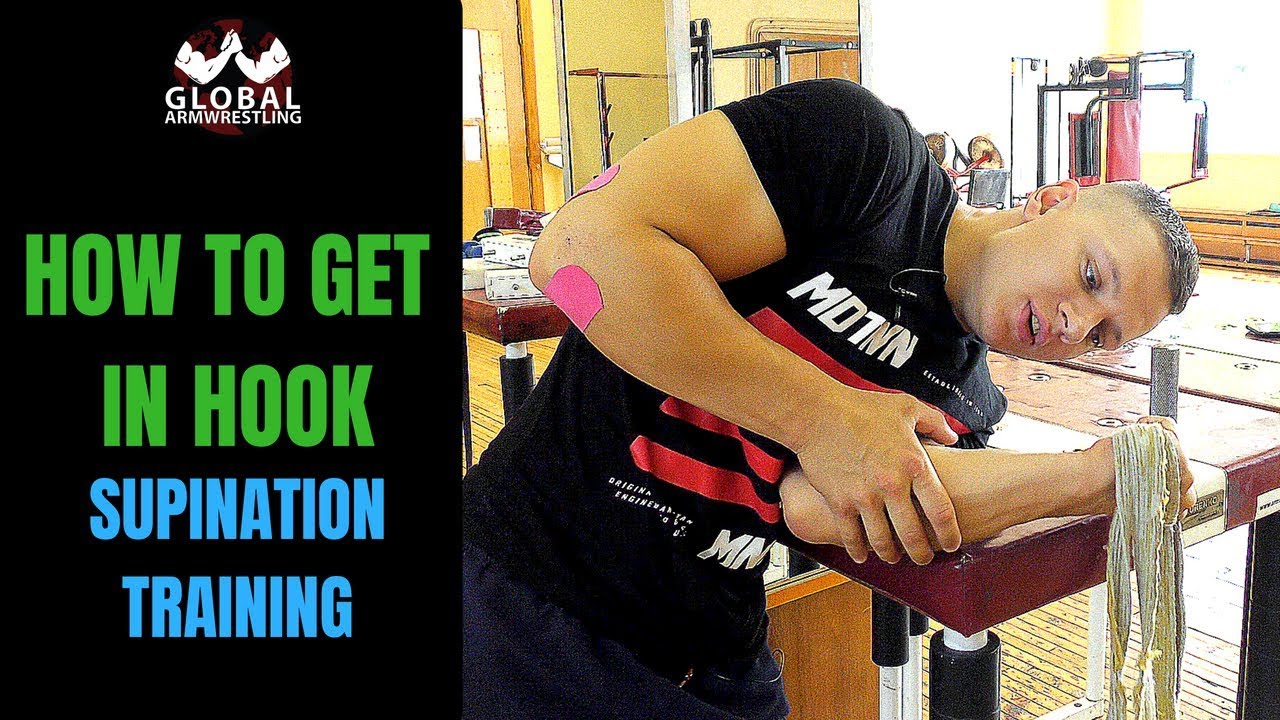
Support the elbow and arrange light resistance that tries to turn the palm down. Supinate against it while preserving the selected wrist angle and keeping the shoulder quiet. Use a modest segment and control the return.
Use two sets of 10–15. Rotation does not substitute for cup. Fix painful thumb pressure or unstable contact before adding load. Reduce or omit isolated rotation when the session already includes substantial inside-entry drilling.
Exercise C: curl or draw the arm closer
Choose a palm-up curl, hammer curl or one-arm row according to the missing task rather than performing all three. Curls retain shoulder control; rows draw the elbow toward the hip with supported torso. Elbow-angle retention and upper-arm drawing are not identical.
Use two sets of 8–12, about three repetitions in reserve and 90–120 seconds rest. Closeness does not mean forcing a painful elbow position. Reduce resistance if the torso can only retreat away from a fixed hand.
A cooperative hook-entry drill
Start at center with explicitly light resistance. Establish cup, containment and inward rotation while retaining pad space. The partner should not counter-hit or contest the pin. Enter, pause briefly, release and reset for a few short repetitions in a roughly five-minute technique block.
If entry requires a lateral hit, reduce difficulty or revise the grip. Do not twist a partner whose hand is fixed while their shoulder moves elsewhere. Resetting and unloading are skills too.
A sample selection without double volume
A gym selection might contain two sets each of cup, curls and supination, with a little extension if appropriate. Meaningful table drills replace some overlapping work rather than being free recovery-wise. An entire extra finger session is unnecessary.
Swap an exercise to match the priority: use a combined handle for containment or a repeatable curl for elbow-angle retention. Changing priorities need not increase total volume. This is an adjustable starting example, not a universal competition program.
Assess position rather than just pins
Track cup on the same handle, comfortable strap contact and whether the final repetition resembles the first. In drills, look for easier entry and deliberate release. Pinning a tired partner is not a reliable isolated training outcome.
The injury review highlights torsion and sudden force changes. Do not retain a losing hook at any cost. Stop for uncontrolled alignment, sharp pain or numbness; persistent symptoms require assessment rather than training through pain.
Exercise video reference
Use the video to study movement order and equipment setup. The sets and repetitions in this guide are Hub's adjustable starting examples for healthy adults, not the filmed athlete's prescription or a pain-treatment protocol.
Read the matching technique guide
Continue the exercise library
- An armwrestling exercise map: what to train, why and where to start
- Training cup: wrist curls, position holds and finger containment
- Finger strength and containment: more than closing a gripper
- Supination training: controlled rotation to support hook entry
- Back-pressure training: elbow-angle retention and drawing the arm back
- High-hook training: height, controlled cup and retained rotation
- Build an armwrestling week: two strength sessions, table time and progression
Sources & further reading
- Voice of Armwrestling — ISOLATED SUPINATION TRAINING FOR ARMWRESTLING
- Voice of Armwrestling — Arm Wrestling Training: Dumbbell Wrist Curls for Cupping
- Voice of Armwrestling — Improve Your Arm Wrestling Technique with the Devon Larratt Multispinner
- Voice of Armwrestling — Arm Wrestling Training: 5 Essential Exercises
- Ogawa và cộng sự, 2022 — tổng quan 153 ca gãy thân xương cánh tay khi vật tay
- ACSM 2026 — khuyến nghị tập sức mạnh cho người trưởng thành khỏe mạnh
- Nguồn hình kỹ thuật / Technique illustration — The armwrestling hook: inside entry, cup and a controlled finish
- Voice of Armwrestling — Hook Technique
- Giấy phép ảnh Wikimedia Commons: CC BY-SA 4.0
- Tarzan / Magazine House — hướng dẫn wrist curl và pronation, ảnh 小川朋央, chỉ dẫn 清水忍