Build an armwrestling week: two strength sessions, table time and progression
An adjustable starting week with sets, repetitions, exercise order, overlap accounting, progression and modifications when table practice becomes demanding.
Contents
A starting framework, not all 18 guides at once
Select exercises to cover tasks, not every exercise name. This framework is for healthy adults learning resistance training. Injured trainees, minors and competition athletes need individual changes; it is not a universally tested armwrestling program.
Two separated sessions, such as Monday and Thursday, provide a trackable structure. Table time is adjusted to recovery rather than being a compulsory third hard day. Replace existing arm/pull work instead of adding this plan intact.
Warm-up and session order
Begin with a few minutes of easy whole-body movement, comfortable joint motion and light rehearsal sets. Check anchors, pins, wear and the lowering path. Aggressive end-range stretching is unnecessary preparation.
Learn technical tasks while fresh, then perform selected general strength, elbow and hand work. Small extension accessories may follow if appropriate. Warming up is not permission to jump to maximal loading.
Session A: pulling, cup and pronation
Row or pulldown: 2 × 10–12. Hammer curl: 2 × 10–12. Supported cup: 2 × 12–15. Light pronation: 2 × 12–15. Leave roughly three to four clean repetitions. Rest 90–120 seconds for pulls/curls and 60–90 seconds for wrist/rotation, longer when needed.
A complete beginner may first use one working set per exercise to learn and observe response. Existing rows or curls count; do not duplicate them because they appear in two written plans.
Session B: pushing and one rotational emphasis
Incline push-up or dumbbell press: 2 × 8–12. Palm-up curl or row: 2 × 10–12. Rise or containment: two sets. Supination or pronation: 2 × 12–15. Use the selected hand exercise's repetition or 8–15-second hold prescription, not both automatically.
Hook learners may choose containment/supination; outside pullers may choose rise/pronation. Press learners still retain pulling and hand work across the week. These are alternative branches, not three programs to stack. Add small extension work only if total loading permits.
Table time counts as loading
Early table practice can emphasize grips, force directions and resets with cooperative resistance. Every repetition need not end in a pin. Reduce nearby demanding rotation or elbow work as table intensity rises; table hours are not free additions.
Spacing sessions is an organizing tool, not proof of complete recovery after exactly 48 or 72 hours. Consider normal function, light rehearsal quality and trends across sessions. A scheduled rest day does not force readiness the next morning.
A two-step progression and useful records
ACSM 2026 emphasizes consistency and goal-appropriate training without obligatory failure. Within 10–15 repetitions, first build toward fifteen across sets with consistent setup, range and reserve. After repeatable sessions, add a small increment and return toward the lower end.
Log date, arm, handle, load, sets/repetitions/time, reserve and next-session response. If increments are too large, add one repetition or repeat the load. New angles, routing or handles require rehearsal and a new comparison baseline.
Harder weeks and individual assessment
If several sessions deteriorate, normal function becomes uncomfortable or light work loses control, reduce sets/load and remove low-priority work. A lighter week, for example roughly halving current set volume, can be an adjustment before reassessing rather than a mandatory monthly rule.
Stop for sharp pain, numbness, swelling or unusual weakness. Persistent symptoms need individual assessment rather than assuming soreness. AAOS rehabilitation guidance is not a general performance plan. Acute deformity or inability to use the arm requires prompt medical care.
Exercise video reference
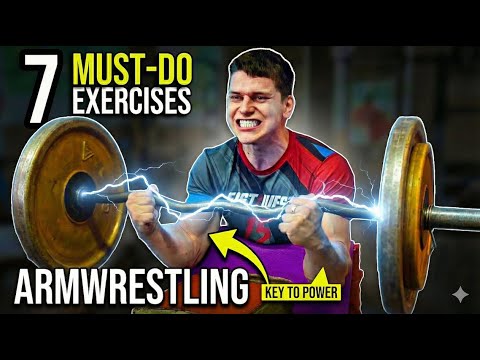
Use the video to study movement order and equipment setup. The sets and repetitions in this guide are Hub's adjustable starting examples for healthy adults, not the filmed athlete's prescription or a pain-treatment protocol.
Continue the exercise library
- An armwrestling exercise map: what to train, why and where to start
- The classic armwrestling strength lifts: curls, rows, pull-ups and triceps
- A hook training session: cup, containment, supination and closeness
- Toproll training: combine pronation, pulling and hand retention
- Press training: triceps, pushing strength and controlled transitions
- Finger strength and containment: more than closing a gripper
Sources & further reading
- Voice of Armwrestling — Arm Wrestling Exercises: 7 Gym Moves for Strength & Table Power
- Voice of Armwrestling — Arm Wrestling Training: 5 Essential Exercises
- Voice of Armwrestling — Strengthening Your Forearms: Effective Wrist Extension Exercises
- ACSM 2026 — khuyến nghị tập sức mạnh cho người trưởng thành khỏe mạnh
- Ogawa và cộng sự, 2022 — tổng quan 153 ca gãy thân xương cánh tay khi vật tay
- AAOS OrthoInfo — nhóm gấp–sấp và đau mặt trong khuỷu
- AAOS — chương trình phục hồi epicondylitis; không phải lịch tăng thành tích vật tay
- Tarzan / Magazine House — hướng dẫn wrist curl và pronation, ảnh 小川朋央, chỉ dẫn 清水忍