Low-hand-toproll training: lower-hand rotation with retained grip
Use low-cable pronation, elbow-angle work and containment while distinguishing a lower-hand strategy from uncontrolled wrist collapse.
Contents
A lower hand is not an abandoned hand
Low-hand toproll accepts a relatively lower hand line to organize rotation, while still needing pronation, pulling and a usable grip. Continuing after an uncontrolled wrist collapse does not automatically create a competent low-hand technique.
Strap routing and cable direction can change the task substantially. Ask whether the load tends to rotate the forearm, open the wrist or open the elbow. Understanding the effect matters more than copying a named online lift.
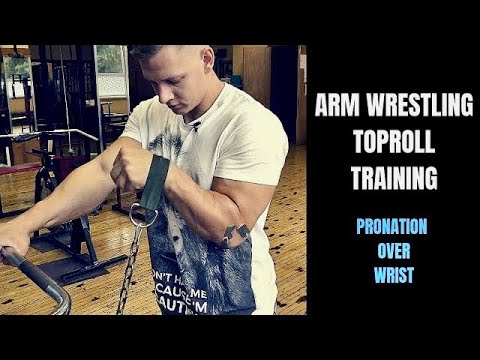
Exercise A: low-cable pronation
Face a low cable steadily with a controllable elbow angle. Route a flat strap so it creates a supinating moment without tightening around the thumb joint. Retain shoulder and wrist control, pronate or hold through a small range and lower slowly.
Begin with two sets of 10–15, leaving three to four repetitions and resting 60–90 seconds. Do not force the wrist into end range to appear lower. Correct a non-rotational strap path before increasing weight.
Exercise B: pull without losing orientation
Reduce load relative to an isolated curl. Retain the selected hand orientation during a short elbow-flexion pull without additional wrist opening or palm-up rotation. Support the elbow and avoid leaning away to lift.
Try two sets of 8–10 instead of another back-pressure lift. Separate rotation and curling if needed, then recombine lightly. Begin with controllable angles rather than the most open position seen in elite matches.
Exercise C: containment or cup
If fingers peel first, select manageable cylindrical-handle holds for two sets of 10–15 seconds, lowering before fingertip loading dominates. If the wrist opens first, use supported wrist curls for two sets of 12–15. Choose one priority.
Do not trap an individual thumb or finger in a strap to imitate match forces. Painful contact may limit a lift before muscle capacity does. Correct the contact point before evaluating grip strength.
Drill: change pressure without a downward hit
With coaching and a cooperative partner, explore a relatively lower hand line at light resistance. Retain pronation and a small pull while the partner reports where pressure reaches the grip. The partner should not resist at any cost.
Reset if the wrist bends beyond the intention, pad space is exhausted or shoulder-hand control is lost. A downward jerk is not proof of a low-hand technique. A few informative repetitions beat fatigued, unassessed pulling.
A sample selection from the general toproll plan
An example uses two sets each of low-cable pronation, orientation-retaining pulls and containment or cup. This is an alternative to a general toproll session, not extra work after completing general and posting programs. Reduce overlapping work when drilling.
A separate day can retain general rows and curls within manageable weekly volume. Reduce demanding rotation and elbow work when table intensity increases. Calling extra work recovery does not make it easy.
Progress under the same routing
Log strap position, cable height, support angle and wrist shape. Add clean repetitions before a small load increment; rehearse again when routing changes. There is no universal low-hand kilogram benchmark across handles and forearm lengths.
The low-cable video demonstrates an exercise rather than proving an optimal answer to every opponent. Choosing when to use the technique remains a table skill. Stop for sharp pain, numbness, finger-joint pain or lost lowering control.
Exercise video reference
Use the video to study movement order and equipment setup. The sets and repetitions in this guide are Hub's adjustable starting examples for healthy adults, not the filmed athlete's prescription or a pain-treatment protocol.
Read the matching technique guide
Continue the exercise library
- An armwrestling exercise map: what to train, why and where to start
- Toproll training: combine pronation, pulling and hand retention
- Pronation training: straps, cables and retaining hand orientation
- Finger strength and containment: more than closing a gripper
- Back-pressure training: elbow-angle retention and drawing the arm back
- Build an armwrestling week: two strength sessions, table time and progression
Sources & further reading
- Voice of Armwrestling — PRONATION EXERCISES WITH LOW CABLE FOR ARMWRESTLING
- Voice of Armwrestling — How To Train Pronation For Armwrestling | 5 Best Exercises
- Voice of Armwrestling — Finger and Grip training (ARM WRESTLING EXERCISE)
- Voice of Armwrestling — Arm Wrestling Exercises: 7 Gym Moves for Strength & Table Power
- ACSM 2026 — khuyến nghị tập sức mạnh cho người trưởng thành khỏe mạnh
- Ogawa và cộng sự, 2022 — tổng quan 153 ca gãy thân xương cánh tay khi vật tay
- Table Monkeys — Low Hand Toproll