

An armwrestling technique map: hook, toproll, press and their variations
Understand hand control, pressure and the main technical families before studying the individual guides. Includes terminology, reading images, transitions and the difference between technique and competition rules.
Contents
A match has more than a sideways force
Technique organizes force through the hand, forearm, elbow and body. Athletes can aim for the same pin while attacking different links: fingers, wrist, elbow angle or the connection between shoulder and hand. Body height and muscular size alone do not identify the move.
The usual starting families are the inside hook, outside toproll and press. High hook, posting and low-hand are variations within that landscape; the King's Move is an advanced outside defensive position. A round can move between families rather than preserving one label throughout.
Six useful concepts
Cup means wrist flexion; pronation and supination are opposing forearm rotations. Pronation is not merely bending the wrist sideways. A constrained grip can carry rotational pressure without a large visible turn.
Rise concerns maintaining the knuckle and thumb-side height. Back pressure draws toward your side; side pressure acts toward the pin side. These components interact. A technical label does not isolate a single muscle or force direction.
Recognizing the families
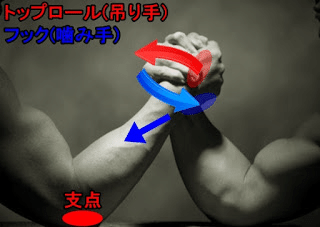
A hook establishes close inside control through cup and containment. A high hook retains more hand height and rotational options rather than immediately burying the grip. A toproll combines pulling and pronation to challenge the opponent's fingers and wrist.
A posting toproll prioritizes height; a low-hand toproll accepts a relatively lower hand line to redirect rotational pressure. A press commits the shoulder and body to a controlled drive. A flop-wrist press accepts an extended wrist but still needs structure. The King's Move is open-angle outside defense, not passive suspension from the elbow joint.
Read the hand, elbow and shoulder together
Ask whose wrist is flexed or extended, which way the palms are being turned, how much pad remains behind the elbow, and whether the shoulder can follow the hand. Camera perspective can hide all four. A still image cannot establish the order of entry or the opponent's response.
The series distinguishes archival photographs, source diagrams and video previews. Arrows describe a coaching model, not an identical path for every anatomy, arm or elbow placement. Matching a famous athlete's silhouette is not evidence that the forces match.
Counters depend on conditions
A toproll may defeat a hook by opening the fingers before containment forms. A hook can stop a toproll by securing closeness and rotation first. A press may finish outside defense only if its user can enter without losing the hand. Strength, timing, straps and the existing position defeat any universal counter chart.
Diagnose the lost connection, not just the move's name. A flattened wrist and a lost riser are different problems. Sometimes the appropriate response is to concede a pin safely rather than attempt a transition without control.
The legal start differs from the live position
A cupped or shoulder-committed demonstration is not permission to start in that position. Officials set the grip before the start; live technique develops afterward within the rules. Straps preserve connection but do not exempt elbow, shoulder or starting violations.
WAF and EVW have distinct wording and foul procedures. The King's Move guide compares the relevant provisions. Historical footage illustrates movement, not the current regulations of every promotion.
Learning order and self-assessment
Learn a legal grip, a controllable body position and an agreed stop command first. Add controlled cup, pronation and pulling, then explore hook and toproll under light resistance. Press transitions require an established shoulder-to-hand connection. Open-angle defense and flop pressing need experienced supervision.
A useful session may rehearse entry and return to center without deciding a winner. Record front and side views and compare positions as resistance changes. If alignment disappears under resistance, adjust the task or load rather than searching for a secret trick.
Safety belongs inside the technique
Watch the competing arm, move with it and avoid rotating the torso inward while the hand is trapped behind. Stop for sharp pain, numbness, lost control or a partner's stop request. No elbow angle or posture guarantees freedom from injury.
Ogawa and colleagues' medical review describes torsional humeral fractures in armwrestling, including cases in different match positions. Use the series for controlled learning, not maximal contests between untrained partners.
Video reference and viewing focus
Voice of Armwrestling separates toproll and hook; the hook chapter starts at 05:04. Watch grip, elbow and shoulder together, then use the individual guides to distinguish variations.
Continue the technique series
- The armwrestling hook: inside entry, cup and a controlled finish
- High hook: retaining hand height in the inside game
- Toproll: hand control through pronation and pulling
- Posting toproll: build a high post without losing the hand
- Low-hand toproll: redirect pressure without surrendering the hand
- King's Move: outside defense, rules and misconceptions
- The armwrestling press: enter with structure, not a shoulder dive
- Flop-wrist press: driving with an extended wrist and its trade-offs
Sources & further reading
- Voice of Armwrestling — Toproll & Hook Explained
- Voice of Armwrestling — Hook vs Toproll
- Mazurenko Japan — hướng dẫn và ảnh hook/toproll, 22/11/2020
- TAWF — Hook, Toproll & Press
- Maharashtra Arm Wrestling Association — Techniques
- WAF Rules 2025 — mục 5.3, 8.1 và 8.3–8.5
- EVW Sports — luật thi đấu hiện hành, mục 4.3–4.5
- Ogawa và cộng sự, 2022 — tổng quan hệ thống gãy xương cánh tay khi vật tay