The armwrestling press: enter with structure, not a shoulder dive
Learn the entry conditions, shoulder-to-hand connection, transitions from other lanes, common failures and the distinction from flop-wrist pressing.
Contents
A press is an organized drive
A press uses shoulder and body position to drive toward the pin, supported by elbow extension and overall arm structure. The label triceps press does not isolate one muscle or make bench-press strength a substitute for table skill.
The body must enter a usable force line while the hand and elbow remain connected. If the opponent separates the hand first, a forward dive may simply rotate the torso around a trapped arm.
Conditions for entering with the shoulder
You need controllable grip connection, a legal elbow and room for the shoulder to approach without violating the rules. Some athletes establish that immediately after Go; others create the opportunity through hook or toproll first.
Cooperatively test whether you can enter and return to center without twisting or lifting the elbow. An entry that works only against a fully relaxed partner is not ready for heavy opposition.
From control to the drive
Once position is established, coordinate body, shoulder and arm along the drive. Do not let the shoulder outrun a distant or backward-pulled hand. Downward and lateral force should remain controllable rather than arriving as a sudden bodyweight drop.
Many presses retain a relatively straight or cupped wrist. That differs from accepting extension in a flop-wrist press. An intact wrist still does not justify continuing after shoulder–elbow control has failed.
Transitions from toproll or hook
After a toproll opens the wrist, the arm may still resist the pin. A press can change the finishing direction if a shoulder entry is available. Preserve control during that transition instead of simultaneously abandoning rotation and diving forward.
A hook-to-press or shoulder-roll transition also needs a usable hand position and body connection. Closeness alone does not guarantee an open drive lane. Rehearse the transition reversibly before adding speed.
Why back pressure can disrupt it
A press requires useful shoulder-to-hand distance and direction. Opposing back pressure can pull the hand beyond that connection. Chasing it by twisting the torso can sacrifice both position and control.
Pulling is not a guaranteed counter to an already structured press. Denying entry and escaping an established drive are different problems.
Shoulder, centerline and elbow limits
Respect the applicable centerline and body-contact rules as the shoulder approaches the hand. A demonstration after Go does not establish a permitted pre-start position.
EVW also specifies elbow contact and pad-boundary requirements. A press must operate within those constraints rather than relying on pad escape or an anticipatory shoulder entry.
Train the entry and the stop
Practice a short, reversible entry against predictable resistance, then test it with gentle opposing pull. Appropriate extension and pressing strength work can help but cannot replace table coordination.
End the effort when connection fails, sharp pain appears or a torso jerk becomes necessary. Progress is a repeatable controlled entry against agreed resistance, not a pin at any cost.
Video reference and viewing focus
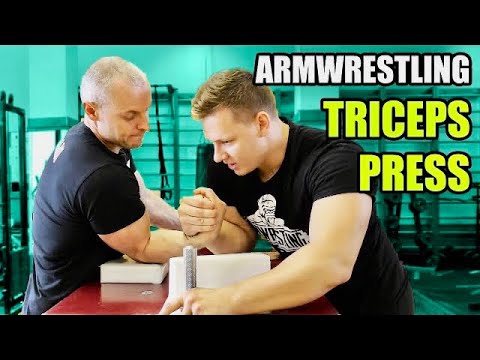
Watch the transition from grip to changing force direction. Pause to inspect the hand, then continue to understand the sequence; a still image cannot substitute for movement.
Continue the technique series
- An armwrestling technique map: hook, toproll, press and their variations
- The armwrestling hook: inside entry, cup and a controlled finish
- High hook: retaining hand height in the inside game
- Toproll: hand control through pronation and pulling
- Posting toproll: build a high post without losing the hand
- Low-hand toproll: redirect pressure without surrendering the hand
- King's Move: outside defense, rules and misconceptions
- Flop-wrist press: driving with an extended wrist and its trade-offs
Sources & further reading
- Voice of Armwrestling — Triceps Press
- TAWF — Hook, Toproll & Press
- Maharashtra Arm Wrestling Association — Techniques
- Voice of Armwrestling — How to Beat Flop Wrist Press
- EVW Sports — luật thi đấu hiện hành, mục 4.3–4.5
- Ogawa và cộng sự, 2022 — tổng quan hệ thống gãy xương cánh tay khi vật tay
- Nguồn hình minh họa / Illustration source