High hook: retaining hand height in the inside game
Learn how height, cup and rotational control interact, why coaches use the term differently, and how the position connects inside pulling with outside transitions.
Contents
First agree what the term means
High hook describes an inside position that retains hand advantage, usually keeping more knuckle and hand height than a deeply curled hook. Coaches do not use the term identically: some describe an entry, others an intermediate position with cup, rise and rotational control.
TAWF uses High Hook as a neutral peak in its own coaching model. That is a system-specific classification, not permission to start a regulated match with a pre-curled wrist. Here the term concerns the live position after Go.
Height at the hand, not a lifted elbow
Hand height concerns knuckles, finger access and a usable forearm angle. It does not require lifting the elbow or shrugging as high as possible. A high-looking hand can remain weak if the wrist, rotation or body connection has failed.
Check cup, thumb-side rotational resistance and shoulder-to-hand connection together. Height without those connections can leave the load hanging on elbow flexion.
Developing the position after the start
Start legally with room for elbow movement. After Go, contain with cup while preserving useful hand height. Maximal supination is unnecessary; many situations require enough active pronation to resist being turned fully palm-up.
Draw the hand into a usable frame and identify whether the opponent is losing fingers or following into an inside grip. Naming the position does not create a lateral finishing advantage. Slow practice makes that distinction visible.
Why a can-opener transition becomes possible
Retained cup and height can let the athlete pressure the grip and redirect into opening the opponent's wrist. A transition often called a can opener can connect hook control with outside-style rotational pressure. It is not individual-finger manipulation, and not every high hook becomes a toproll.
Maintain connection while changing the force emphasis. Abruptly abandoning cup or running out of elbow pad can lose both lanes.
Distinguishing deep hook and posting toproll
Compared with a deep hook, high hook generally preserves more height and less complete palm-up commitment. Compared with posting toproll, its central aim remains inside containment rather than climbing and stripping from outside. Real positions can sit between the labels.
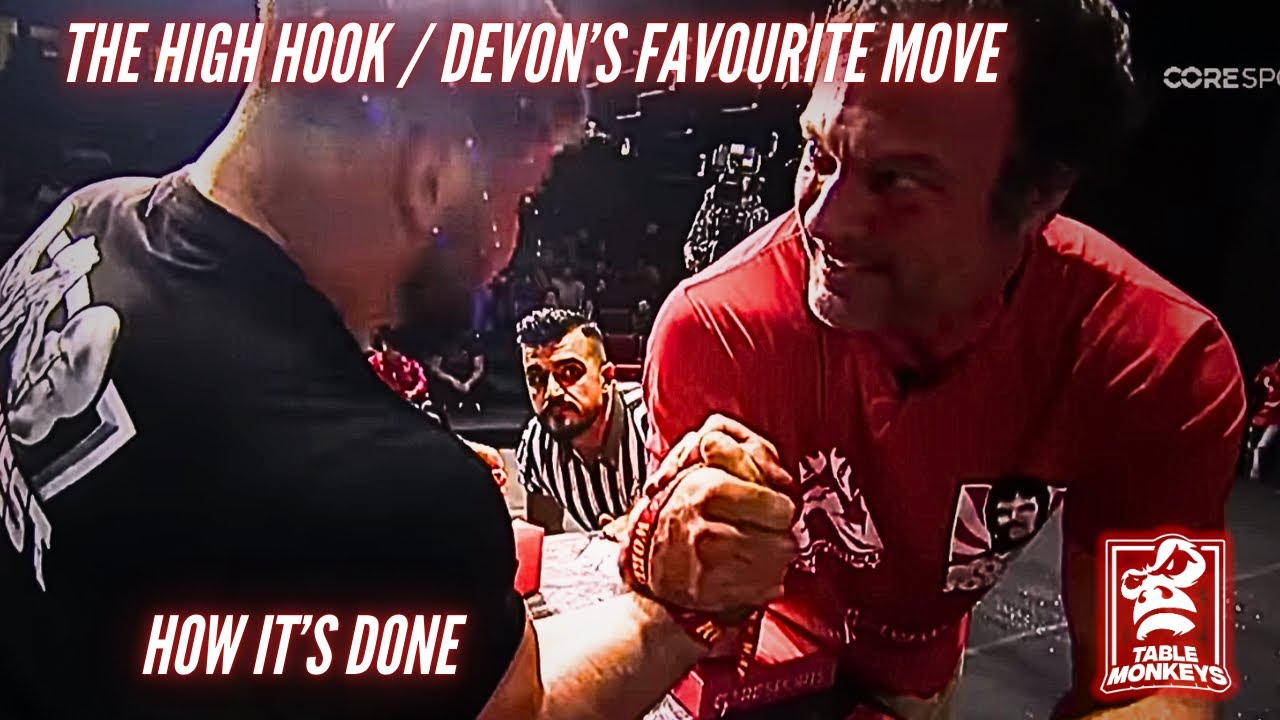
The Table Monkeys preview leads to a video reference, not a universal joint-angle template. The accompanying hook diagrams illustrate the family, not proof that each pictured position is specifically a high hook.
Responses and common errors
An opponent may attack height, open the cup with pronation or separate the hand from the body. Diagnose which connection is failing; deeper hooking or dropping lower is not a universal rescue.
Frequent errors include an excessively high but uncontainable grip, treating cup and pronation as mutually exclusive, premature body rotation and hanging on elbow flexion after shoulder separation. Rebuild cooperatively rather than wrenching a lost position.
Drill retained options rather than endurance alone
Use low resistance while the partner separately tests cup, height and distance. Identify the first incoming pressure instead of holding indefinitely. End the drill when torso compensation replaces hand control.
Then rehearse a slow transition toward an outside lane and back to center. Being able to reverse it under light load shows understanding, not readiness for competition intensity. Add resistance and side pressure with supervision.
Video reference and viewing focus
Watch the transition from grip to changing force direction. Pause to inspect the hand, then continue to understand the sequence; a still image cannot substitute for movement.
Continue the technique series
- An armwrestling technique map: hook, toproll, press and their variations
- The armwrestling hook: inside entry, cup and a controlled finish
- Toproll: hand control through pronation and pulling
- Posting toproll: build a high post without losing the hand
- Low-hand toproll: redirect pressure without surrendering the hand
- King's Move: outside defense, rules and misconceptions
- The armwrestling press: enter with structure, not a shoulder dive
- Flop-wrist press: driving with an extended wrist and its trade-offs
Sources & further reading
- Table Monkeys — The High Hook / How It's Done
- TAWF — cách định nghĩa High Hook trong hệ thống của họ
- Mazurenko Japan / GLINT — đường chuyển động hook
- Gegns Gym — Hook và các biến thể
- Voice of Armwrestling — Toproll & Hook Explained
- EVW Sports — luật thi đấu hiện hành, mục 4.3–4.5
- Nguồn hình minh họa / Illustration source